
Markets

A bridge between BiH and international markets.

Local insight, global perspective — connecting Bosnia & Herzegovina with international opportunities.

For companies from BiH

We help companies from Bosnia and Herzegovina identify new clients, partners and markets, and present their products and services to the international business community.

  • 01Access to buyers, distributors and channel partners across the EU, Nordics, Gulf and Central Europe
  • 02Positioning and go-to-market narrative built for international audiences
  • 03Structured participation in trade missions, sector visits and matchmaking programmes
  • 04On-the-ground representation and follow-through in target markets
For international companies

We help international businesses identify reliable partners, suppliers and collaboration opportunities in Bosnia and Herzegovina.

  • 01Market intelligence, regulatory mapping and entity structuring for BiH
  • 02Vetted introductions to operators, suppliers and institutional partners
  • 03Local site, supplier and recruitment scouting
  • 04Continuous senior representation between visits

Local insight. Global perspective.

Every market has its own rhythm. Ours is a practice of translation — between languages, institutions and business cultures — so that first meetings turn into working relationships.

Investor guide

Investing in Bosnia and Herzegovina

A practical overview for international companies evaluating Bosnia and Herzegovina as a nearshoring, manufacturing, or expansion base — covering the regulatory environment, tax structure, and sectors where foreign capital is finding traction.

Regulatory framework

Foreign investors receive national treatment under the state-level Law on the Policy of Foreign Direct Investment. Capital and profits can be freely repatriated, and property rights are constitutionally protected. Company registration is handled at the entity level — in the Federation of BiH, Republika Srpska, or Brčko District. Bosnia and Herzegovina is an EU candidate country, progressively aligning commercial law with EU standards.

Tax structure

Corporate income tax is a flat 10% in both entities, one of Europe's most competitive rates. VAT is a unified 17%, and personal income tax is 10% in the Federation and 8–10% in Republika Srpska. A network of double-taxation treaties covers most EU member states, the UK, Turkey, and the Gulf. These agreements reduce withholding tax on cross-border dividends, interest, and royalties.

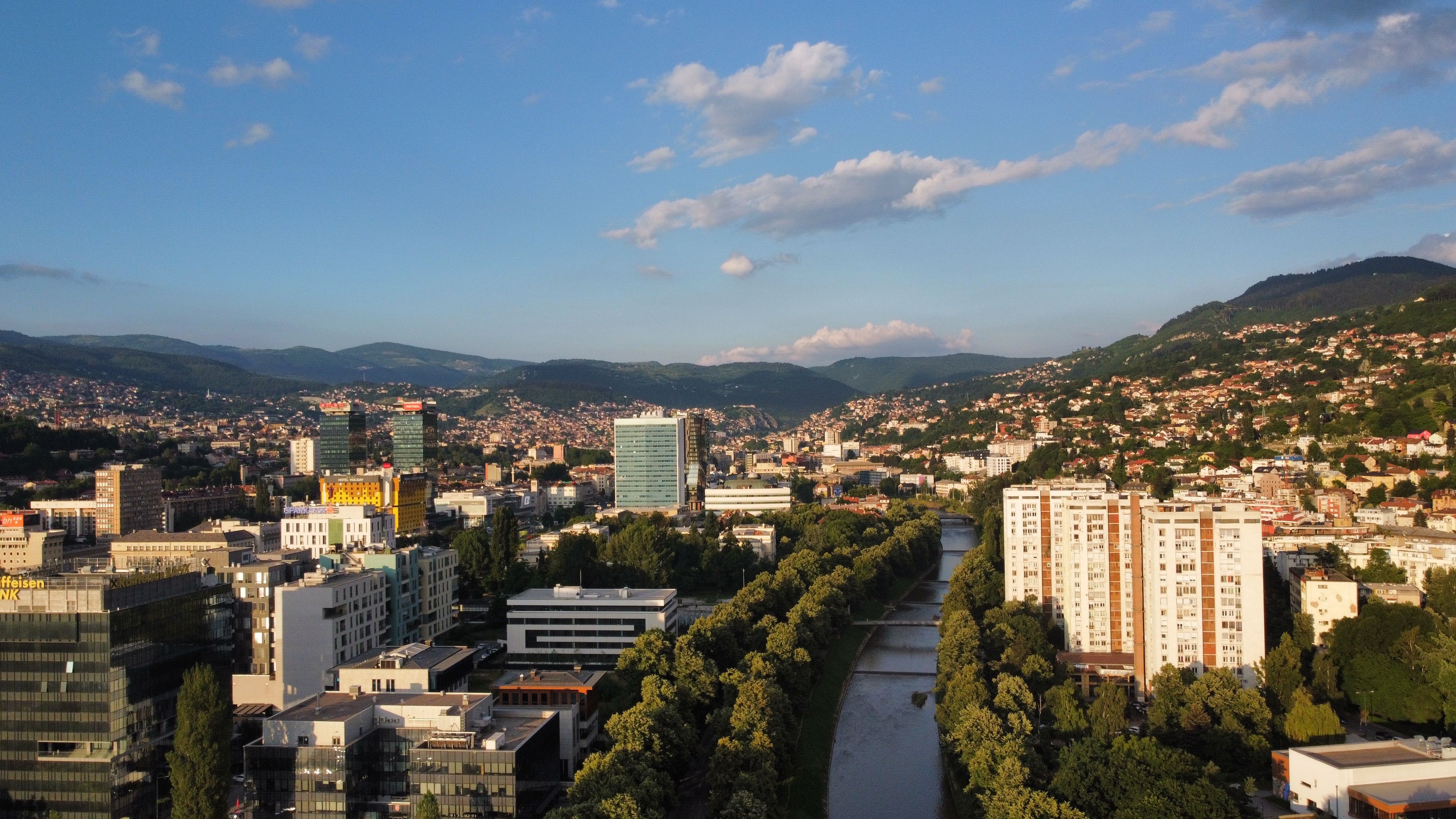
View over Sarajevo showing the intersection of European and Ottoman architecture
Sarajevo — Bosnia and Herzegovina's capital and primary commercial hub.

Sector opportunities

01

Manufacturing & metalworking

Established supplier base for European OEMs in automotive, machinery, and metal components, with competitive labour costs and CEFTA access.

02

IT & software services

Growing pool of engineers serving EU and US clients through nearshoring, with strong English proficiency and time-zone overlap.

03

Energy & renewables

Hydro, wind, and solar potential backed by feed-in tariffs and long-term power purchase frameworks.

04

Agribusiness & food processing

Fertile land, protected geographical indications, and duty-free access to CEFTA and EU markets under the Stabilisation and Association Agreement.

05

Wood processing & furniture

Certified forestry base supplying finished furniture and components to Western European retailers.

06

Tourism & hospitality

Fast-growing inbound tourism across Sarajevo, Mostar, and the Adriatic-adjacent regions, with room for branded hotel and resort development.

Stari Most bridge in Mostar, a symbol of the country's trade and cultural crossroads
Positioned to trade

A crossroads market with tariff-free reach into 550M consumers.

Sitting between the EU and the Western Balkans, Bosnia and Herzegovina combines low operating costs with layered trade agreements — a practical base for companies producing for European supply chains or scaling into the region.

Frequently asked questions

Can foreign investors own 100% of a company in Bosnia and Herzegovina?

Yes. Foreign investors can hold up to 100% ownership in most sectors, with national treatment guaranteed under the Law on the Policy of Foreign Direct Investment. A limited list of strategic sectors (defence, certain media) has ownership caps.

What is the corporate tax rate?

Corporate income tax is 10% in both the Federation of BiH and Republika Srpska, among the lowest flat rates in Europe. VAT is a unified 17%.

How long does it take to register a company?

A limited liability company (d.o.o.) can typically be registered in 3–6 weeks, depending on the entity and municipality. Bizantrop handles the full process end-to-end.

Are there incentives for foreign direct investment?

Yes — incentives include tax relief for capital investments and R&D, customs exemptions on equipment imports, and entity- and canton-level grants tied to job creation and export orientation.

Does Bosnia and Herzegovina have free trade access to the EU?

Yes. The Stabilisation and Association Agreement provides duty-free access to the EU for most industrial and many agricultural goods, and CEFTA membership adds free trade with the Western Balkans.

Tell us what you want to build in Bosnia & Herzegovina.